WSI vs Sydney Kingsford Smith Airport
Two airports, one city. Here's what's actually different.
Last updated: 11 April 2026
From October 2026, Sydney will have two international airports for the first time. Western Sydney International (WSI) opens at Luddenham on 26 October — and it comes with something Kingsford Smith hasn’t had since 1995: the legal right to operate through the night without restriction. That’s the headline. But the full story is more interesting than “WSI good, KSA bad,” and anyone telling you otherwise is selling something. Here’s an honest look at what’s actually different and how to decide which airport to use.
Two Sydney Airports
Sydney Kingsford Smith (IATA: SYD) is the established airport: located at Mascot, roughly 9 kilometres south of the CBD, it has been Australia’s busiest international gateway for decades. The train from Central takes around 13 minutes on the Airport Link; a cab from the city runs 20 to 30 minutes in light traffic. It has more airlines, more routes, and more lounges than WSI will have at opening. For most of the international flights Australians take — Europe, the US, most of Asia — Kingsford Smith is where you’re going, at least for now.
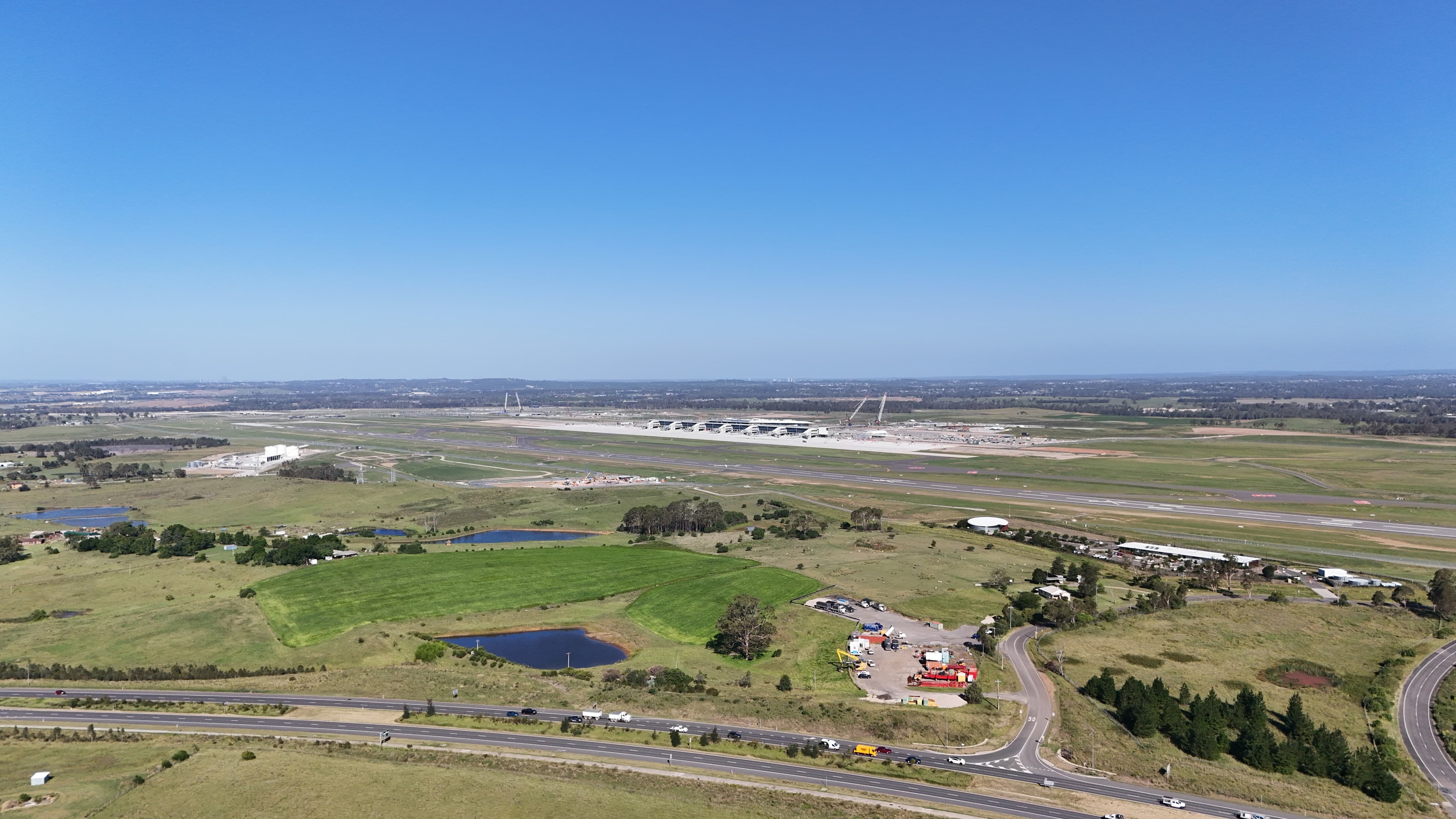
Western Sydney International (IATA: WSI) opens for passenger flights on 26 October 2026 at Luddenham, approximately 44 kilometres west of Sydney CBD. The operator is WSA Co Limited, a Commonwealth-owned company. The airport sits on 1,700 hectares of land the federal government has held since the 1980s and features a single 3,700-metre runway capable of handling widebody aircraft up to the A380. Terminal capacity at opening is 10 million passengers a year. It will not have dozens of airlines on day one. But it will have something Kingsford Smith legally cannot offer: the ability to depart at midnight.
Curfew vs No Curfew
WSI doesn’t have a curfew, and that’s the single biggest practical difference between the two airports — but it’s a more interesting story than “no restrictions.” Here’s what nobody tells you about the curfew situation.
Sydney Kingsford Smith has operated under the Sydney Airport Curfew Act 1995 for over thirty years. Under that Act, most scheduled flights are prohibited between 11pm and 6am. There are narrow exemptions — unscheduled diversions, some freight operations, and a small number of grandfather-clause slots — but the practical effect is that no new scheduled international departure can leave Kingsford Smith after 11pm. This is why Sydney misses out on certain late-night routes and why some airlines schedule their Sydney legs to arrive in the early morning: they have no choice about it.
WSI operates under different legislation entirely. It was established under the Airports Act 1996, and no equivalent curfew applies. The Department of Infrastructure has confirmed in a published fact sheet that WSI will be curfew-free and open every day of the year. No movement caps. No aircraft weight limits at night. The airport’s own Master Plan states it plainly: WSI is “unique, being a greenfield airport in an area that is mostly rural or semi-rural land” and has the potential to reach full capacity “while maintaining 24/7 unrestricted operations.”
Singapore Airlines is the clearest proof that this distinction matters commercially. Their daily Airbus A350-900 service launches from WSI on 23 November 2026. Flight SQ202 departs WSI at 23:55, arriving in Singapore at 05:05 the next morning. That departure would be prohibited at Kingsford Smith under the 11pm curfew — full stop. Singapore Airlines put it directly in their own promotional language: “A curfew-free airport means more choices when it matters. Spend the evening in Sydney and wake up for breakfast in Singapore.” That’s not marketing spin. It is a description of something concrete: a flight time that literally cannot exist at the other airport. When a major international carrier builds its scheduling strategy around your curfew status, the advantage is real.
Now — the caveat, and it matters. WSI and Kingsford Smith both sit under the same “Sydney” designation in Australia’s bilateral air services agreements. These treaties control how many seats each foreign country’s airlines can sell on routes into and out of Sydney. WSI’s curfew-free status does not override this. If a foreign airline has exhausted its Sydney capacity allocation, it cannot serve WSI — regardless of the curfew advantage. Qatar Airways is currently blocked by this constraint and has publicly called for reform. Qantas cannot launch a planned Bali service from WSI because of the Indonesia bilateral cap. Prime Minister Albanese explicitly declined to commit to easing restrictions when asked at the April 2025 Western Sydney Leadership Dialogue, stating the framework will be reviewed after one year of operations — meaning not before late 2027 at the earliest.
The practical read: WSI’s curfew-free advantage is real and commercially significant for the carriers confirmed at launch — Singapore Airlines and Qantas Freight have both explicitly cited it as a key reason for operating at WSI. But it does not mean WSI is open to any airline that wants to fly there. The bilateral framework still controls who shows up, and that won’t change overnight.
Drive Times Compared
WSI is further from the Sydney CBD. That’s just true, and it matters if you live on the eastern side of the city. When Air New Zealand announced their WSI services in April 2026, they published a comparison table: driving from Sydney CBD to Kingsford Smith takes approximately 20 to 30 minutes; to WSI, they quote approximately 60 minutes. That’s a real difference — roughly double the drive in each direction, before you factor in peak-hour traffic on the M4 corridor.
But “further from the CBD” is a CBD-centric view of a city that sprawls well west of the CBD. If you’re travelling from Penrith, WSI is approximately 25 to 35 minutes away. From Liverpool, also 25 to 35 minutes. Compare that to the drive from Penrith to Kingsford Smith — easily 60 to 70 minutes under normal conditions, more in the afternoon peak. For the roughly two million people who live west of Parramatta, WSI is genuinely the closer option. The Blue Mountains, Wollongong, and Canberra all sit in WSI’s natural catchment: Katoomba is around 55 minutes north-west of the airport, and the Canberra drive — approximately 2 hours 45 minutes to 3 hours 30 minutes via the M12/M7/Hume corridor — is broadly comparable to the drive from Canberra to Kingsford Smith, since WSI sits further along the same motorway route.
For public transport in 2026, Kingsford Smith has the clear advantage. The Airport Link train runs to Central in around 13 minutes. WSI’s Metro connection opens in 2027, not with the airport in October 2026. In the interim, a free WSI Link bus shuttle runs every 30 minutes between the airport and St Marys station — the ride takes around 30 minutes, then you’re on the T1 Western Line to Parramatta, Blacktown, or the city. It works, but it’s not 13 minutes to Central. That gap closes substantially when the Metro opens.
The two airports are roughly 41 kilometres apart as the crow flies, or 45 to 50 kilometres by road via the M12/M7/M5 route — about a 40-minute drive between them under normal conditions. That figure matters if you’re making a connecting flight decision or picking up a passenger who has landed at the wrong Sydney airport.
Note: KSA parking rate comparisons will be added to this page once confirmed data is available. Sydney Airport’s current fare schedule is published at sydneyairport.com.au.
Airline Lineups
This is where Kingsford Smith has a substantial, real advantage — and it will for several years. KSA has an established network of international carriers covering most major destinations directly. No equivalent list exists for WSI at launch, and it’s worth knowing exactly what does.
At opening on 26 October 2026, WSI’s confirmed international carriers are Air New Zealand (Auckland, three times a week on Monday, Wednesday, and Friday) and Singapore Airlines (Singapore, daily from 23 November 2026 — a month after the airport opens). Domestically, QantasLink will operate to Melbourne, Brisbane, and the Gold Coast using up to five Embraer E190 regional jets; Jetstar will serve the same three cities with up to ten A320-family aircraft. No Qantas lounge has been announced for WSI as of April 2026. That is the confirmed passenger lineup — nothing more as of this writing.
There’s a specific detail worth knowing if you’re choosing between WSI and KSA for the Auckland route. Air New Zealand is running economy class only at WSI at launch. Their parallel Kingsford Smith services — to Auckland, Wellington, Christchurch, and Queenstown — all include Premium Economy and Business class. If you’re travelling on Airpoints or expecting a lie-flat seat, that flight currently lives at KSA. Air New Zealand has confirmed their Kingsford Smith routes are unaffected by the WSI launch.
WSI’s airline lineup is expected to grow through 2027 and beyond as more carriers confirm routes and the bilateral framework evolves. For the full picture of what’s confirmed and what’s coming, see the WSI Airlines & Routes page.
Which One Should You Use?
Honest answer: in 2026, most international travellers will still use Kingsford Smith most of the time. More airlines, more routes, more lounges, and significantly faster to reach from the CBD and Eastern Suburbs. If any of those matter to your trip, use KSA.
Use WSI if:
- You live west of Parramatta. Penrith, Liverpool, Campbelltown, Fairfield, St Marys — for most of Western Sydney, WSI is the genuinely closer airport by 30 to 40 minutes each way.
- You’re travelling from the Blue Mountains, Wollongong, or Canberra. WSI sits on the western motorway corridor and is naturally better-placed for these origins. From Katoomba, you’re at WSI in around 55 minutes.
- You want the Singapore Airlines late-night departure. SQ202 leaves WSI at 23:55 — you get the full day in Sydney, sleep on the A350, and arrive in Singapore at breakfast. That timing does not exist at Kingsford Smith.
- You’re flying Auckland on Air New Zealand in economy. WSI has the route from opening day, and a brand-new terminal is a noticeably better experience than the dated international pier at KSA.
Use KSA if:
- You need a route WSI doesn’t have. In 2026 that covers most of the world — WSI serves Auckland and Singapore internationally, plus Melbourne, Brisbane, and Gold Coast domestically.
- You want premium cabin international travel. Business class, established lounges, greater frequency — KSA has these in 2026, WSI does not.
- You’re coming from the CBD or Eastern Suburbs. The time saving is real and the train connection is hard to beat.
- You need public transport in 2026.The Airport Link to Central is 13 minutes. WSI’s Metro doesn’t open until 2027 — in the interim, expect a 30-minute bus plus a train.
This comparison will look different by 2028. More carriers will have confirmed WSI services, the Metro will be running, and the bilateral framework will be under active review. This page will be updated as the picture changes.