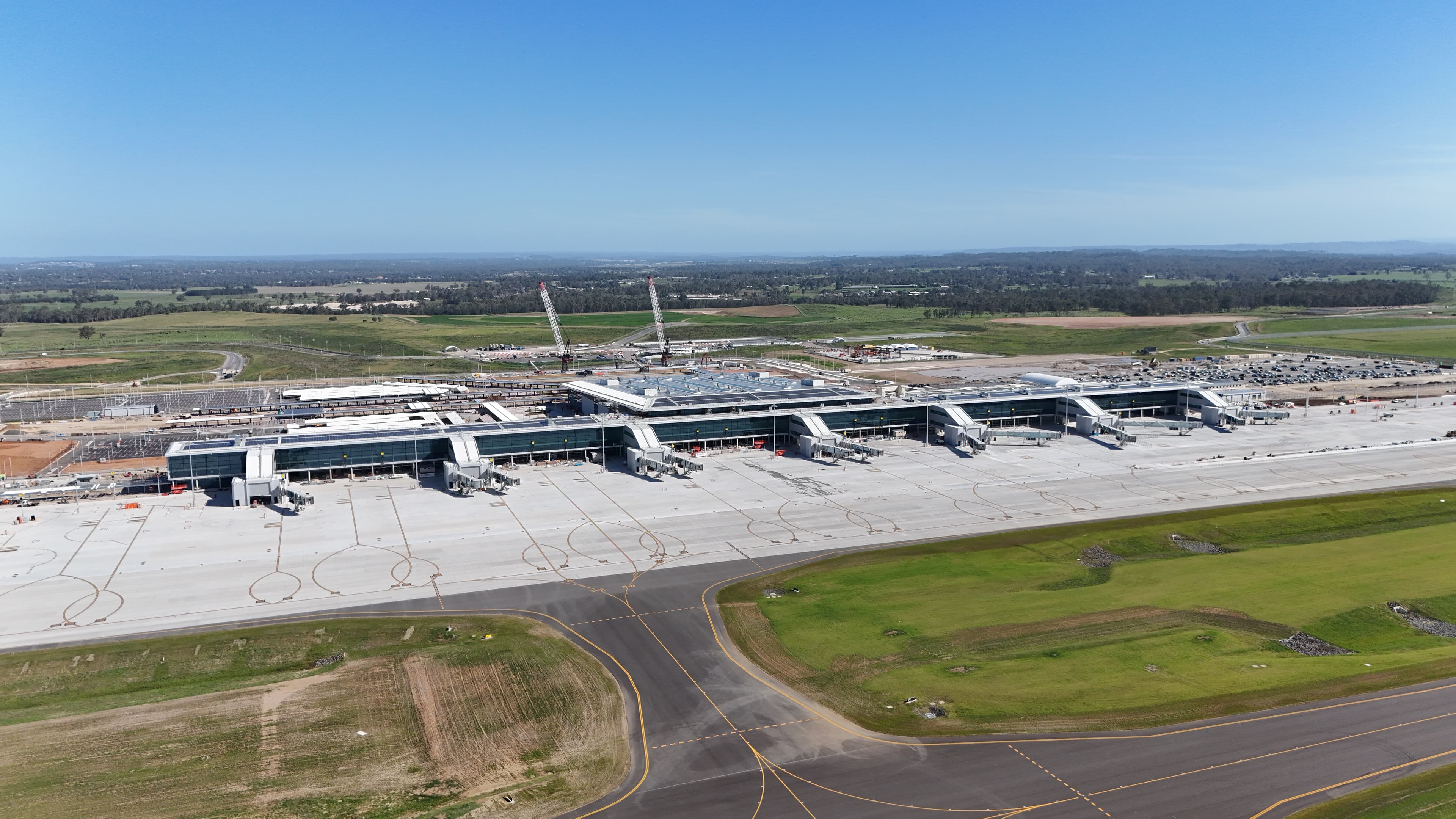
Western Sydney International (Nancy-Bird Walton) Airport
Opening 25 October 2026. Sydney's second airport, designed for the future.
Plan your arrivalLast updated: 21 October 2026
Plan Your Visit
Western Sydney International (Nancy-Bird Walton) Airport opens for passenger flights on 25 October 2026 — and it’s already doing something Sydney hasn’t had in decades: a major international airport with no overnight curfew. WSI sits in Luddenham, about 50 kilometres west of the CBD, built on 1,780 hectares of Commonwealth land set aside for this purpose since the 1980s. This page covers what it is, who’s flying there, how big it will be, and what the curfew-free status actually means once you cut through the marketing language.
What is WSI?
The official full name is Western Sydney International (Nancy-Bird Walton) Airport — the Nancy Bird Walton part honours the pioneering Australian aviator who died in 2009, with the naming announced on 4 March 2019. The operator uses the short form WSI; you’ll also see WSA in older documents. IATA code: WSI. ICAO code: YSWS.
The airport is built and operated by WSA Co Limited (ACN 618 989 272), a company wholly owned by the Commonwealth of Australia. CEO Simon Hickey has been steering it through the operational testing phase since construction wrapped. It’s not a privatised asset — no sale process is underway.
The site covers approximately 1,780 hectares in Badgerys Creek and Luddenham, within the Liverpool City Council local government area — that’s 17.8 square kilometres, roughly the footprint of a mid-sized country town. It sits about 50 kilometres west of Sydney CBD, 15 kilometres south of Penrith, and 20 kilometres north of Campbelltown. My uncle drove past those paddocks for thirty years on his way between Liverpool and Penrith. He keeps a photo of the old view on his fridge now, with the control tower in the same spot where the gum trees used to be.
The site sits on the traditional Country of the Cabrogal people of the Dharug Nation. Archaeological investigations identified over 70 cultural heritage sites within the airport boundaries — artefacts, a grinding groove, and a scar tree among them. WSA Co has established a First Nations Advisory Group and formally acknowledges Country in its planning documents.
Opening Date
The airport opens for cargo operations on 26 July 2026 and for passenger flights from 25 October 2026— both dates confirmed by a ministerial media release in June 2026. The first commercial passenger flight is Jetstar JQ362 to the Gold Coast at 11:00am on 25 October, fares from $59. Air New Zealand's inaugural Auckland service (NZ166) follows on 26 October.
Singapore Airlines launches its daily WSI–Singapore service on 23 November 2026, a month after the airport opens. Beyond that initial wave, the route network is expected to grow through 2027 and beyond as more carriers confirm services. The Sydney Metro Western Sydney Airport line is expected to open mid-to-late 2027, not with the airport — there’s a free bus shuttle covering that gap from day one (more on that in the “What This Means for Travellers” section below).
Airlines and Routes
At opening, WSI has three confirmed passenger carriers with published schedules. Jetstar operates the first-ever commercial flight from WSI — JQ362 to the Gold Coast at 11:00am on 25 October, fares from $59 — followed by Melbourne (14x weekly) and Brisbane (3x weekly) on Airbus A320s. Air New Zealand launches WSI–Auckland on 26 October (3x weekly, Mon/Wed/Fri, Economy only). Singapore Airlines begins daily A350-900 services to Singapore Changi from 23 November 2026 — flight SQ202 departs at 23:55, a departure time prohibited at Sydney KSA under the curfew.
Qantas mainline launches 28 March 2027 — not at the October opening. Qantas will operate Brisbane and Melbourne services via Alliance Airlines on Embraer E190 jets (wet-lease). The E190 seats around 95 passengers in a 2-2 configuration — smaller than the A320s Jetstar operates. No Qantas lounge has been confirmed at WSI.
Emirates and Qatar Airways received formal government bilateral clearance in May 2026 for services through WSI — UAE carriers collectively gained 7 additional weekly services, Qatar carriers gained 7. No launch dates have been confirmed and tickets are not yet on sale for either carrier. Virgin Australia and Rex have not announced WSI routes.
Qantas Freight is the first Qantas Group operation at WSI — inaugural freighter on 27 July 2026, one day after the cargo precinct opens. A321 and A330 freighters operate from a dedicated 24,000 sqm facility; overnight cargo runs prohibited at KSA are possible at WSI from day one.
The airlines and routes page is updated as new announcements come in.
How Big Is It?
Big — and designed to get much bigger. The terminal handles up to 10 million passengers per year at opening. According to the WSI Master Plan 2025–45 (endorsed May 2026), the central passenger forecast is 8.4 million by 2030 — 5.4 million domestic and 3.0 million international. By 2045 that flips: the WSI Master Plan 2025–45 projects 11.1 million international passengers against 8.2 million domestic, a total of 19.3 million annually. The single runway can handle approximately 37 million passengers per year before a second parallel runway is needed; earthworks for that second runway are planned to begin shortly after the airport opens, with commissioning expected in the mid-2050s.
The site covers approximately 1,780 hectares — 17.8 square kilometres of Commonwealth land. WSA Co has allocated 644 hectares of that for aviation support and commercial uses. The runway is 3,700 metres long by 45 metres wide, designated Runway 05/23 and aligned southwest–northeast. Category IIIB ILS is fitted at both ends of the runway, meaning the airport can handle landings in very low visibility — decision height below 50 feet, visibility below 200 metres. WSI is one of only three Australian airports with CAT IIIB ILS; the others are Sydney Kingsford Smith’s main runway and Melbourne Airport’s main runway. Runway usability: 99.5%.
At opening there are 13 MARS passenger stands — a MARS (Multiple Aircraft Ramp System) stand can handle either two narrow-body aircraft or one wide-body, giving the terminal real flexibility to match stands to fleet mix. Eight cargo stands operate on a separate apron. The long-range target is 82 million passengers per year with two runways, four interconnected terminals, and an automated people mover connecting them — planned for approximately the 2060s. That’s a projection, not a promise.
The Curfew-Free Advantage
Sydney Kingsford Smith Airport has operated under a legislated curfew since 1995: most flights are prohibited between 11pm and 6am. It’s one of the primary reasons airline planners have been arguing for a second Sydney airport for thirty years. WSI is not subject to that law.
The legal basis is straightforward. The Sydney Airport Curfew Act 1995 (Cth) applies specifically to Kingsford Smith. WSI operates under the Airports Act 1996 and the Airports (Western Sydney International Airport) Act 2022, neither of which imposes a curfew. The Department of Infrastructure has confirmed in a published fact sheet: “WSI will be curfew-free and operate every day of the year.” No movement caps apply either. The WSI Master Plan 2025–45 (endorsed May 2026) states plainly that WSI “has the potential to reach its long-range and ultimate capacity while maintaining 24/7 unrestricted operations.”
What this looks like in practice: Singapore Airlines has scheduled flight SQ202 to depart WSI at 23:55 and land in Singapore at 05:05 the next morning. You can book a seat on that flight right now. That exact departure slot is unavailable at Kingsford Smith. Singapore Airlines is not subtle about why they chose WSI for it.
There is, however, a caveat worth understanding clearly. WSI and Sydney Kingsford Smith both fall under the same “Sydney” metropolitan designation in Australia’s bilateral air services agreements — the international treaties that govern how many seats each foreign airline can operate to Sydney. An airline that has used up its Sydney capacity allocation cannot simply add flights at WSI regardless of the curfew-free status. The government addressed the most acute cases in May 2026: bilateral agreements with the UAE and Qatar were updated to grant each country's airlines 7 additional weekly services through WSI specifically. Emirates and Qatar Airways are now cleared to operate — the constraint has been lifted for them. Other markets (US, China, UK) may require their own bilateral updates as WSI grows.
So the accurate description: WSI has no overnight curfew and no movement caps. The bilateral framework still governs international capacity, but the government is actively updating those agreements as new carriers seek to operate from WSI. Airlines from New Zealand and Singapore had open rights with available capacity from day one — which is why Air New Zealand and Singapore Airlines are first in.
Construction and History
This airport has been forty years in the making, in the most literal sense. The Commonwealth began acquiring farmland at Badgerys Creek in the 1980s — roughly 200 rural residential properties over several years, progressively consolidated into a single parcel of Commonwealth land. The site sits on the Country of the Dharug people, the Traditional Custodians of the greater western Sydney basin. The airport’s development has included consultation with Dharug and Gandangara communities under the Aboriginal Cultural Heritage Assessment process, and the Master Plan acknowledges the site’s cultural significance to First Nations peoples. The site sat mostly unused for decades while governments at both levels debated and delayed. The Airport Plan wasn’t approved until December 2016. Construction commenced on 24 September 2018.
What happened after that was, by the standards of major Australian infrastructure, unusually clean. Terminal construction completed on 11 June 2025, seven months ahead of schedule. Bechtel confirmed on 26 June 2025 that delivery was within the A$5.3 billion construction budget. A Boeing 737-700 operated by the NSW Rural Fire Service became the first large aircraft to land on the runway, during an emergency exercise on 28 October 2025. From April 2026, the airport has been in operational testing and systems commissioning — CEO Simon Hickey described it as getting “match-fit.”
The total investment picture extends well beyond the construction contract. The Sydney Metro Western Sydney Airport line cost approximately A$11 billion, split 50/50 between the Commonwealth and NSW. The Western Sydney Infrastructure Plan — the road network around the airport, including the A$2.1 billion M12 Motorway — added approximately A$4.4 billion more. The Australian Government’s own figure for total western Sydney investment across all related projects is approximately A$19 billion.
The terminal design competition was won by Cox Architecture and Zaha Hadid Architects, with detailed development by Woods Bagot. Air traffic control is handled via a Digital Aerodrome Service (DAS) operated by Airservices Australia — not a conventional tower. The WSI Master Plan 2025–45 (endorsed May 2026) describes WSI as Australia’s first airport without a traditional air traffic control tower.
Two commercial concession partners have been publicly confirmed. Lagardère AWPL — the Australian arm of the global travel retail group — has been awarded the duty-free and specialty retail concession. Lagardère operates duty-free at Sydney KSA, Melbourne, and Brisbane; WSI gives them a fourth Australian airport gateway. The second confirmed partner is JCDecaux, which has secured the airport advertising and digital screen concession — the firm that operates advertising networks at Sydney KSA, Melbourne, and international airports across Europe and Asia. Together these announcements confirm that WSI’s terminal retail layer will be operational from opening day, not retrofitted later.
What This Means for Travellers
Here’s the honest picture for someone flying into WSI from October 2026.
Transport: at opening, around 90% of airport users are expected to travel by personal vehicle, according to the WSI Master Plan 2025–45 (endorsed May 2026). That’s not a criticism of the airport — it’s just the reality when the Metro hasn’t opened yet. Until the Metro opens (mid-to-late 2027), Transport for NSW is running a free WSI Link bus shuttle every 30 minutes between the airport and St Marys station on the T1 Western Line, operating 4:30am to midnight Sunday through Thursday and until 1:00am on Friday and Saturday nights. The M12 Motorway, which opened toll-free on 14 March 2026, connects WSI to the M7 at Cecil Hills — drive times run approximately 45–55 minutes from Sydney CBD, 25–35 minutes from Penrith or Liverpool.
For parking, WSI opens with more than 6,000 spaces across four car parks, including EV charging stations. Launch rates were published in October 2026: long-stay from around $15 a day, a mid-tier saver around $29, and premium parking around $49, with the first three hours free and a free 15-minute drop-off zone. These are introductory rates held to April 2027 — book ahead for opening week, and check wsiairport.com.au for the current figure before you go.
The terminal is a single integrated building handling both domestic and international passengers — no separate international terminal to find, no inter-terminal transfers. The design target is IATA’s ‘optimum’ Level of Service: individual check-in queues under 3 minutes, security under 5 minutes, border control under 10 minutes. Those are design targets, not operational guarantees — opening-day realities at any new airport vary.
When the Metro opens in mid-to-late 2027, the picture shifts. By 2045, the WSI Master Plan 2025–45 projects 21% of passengers travelling by train — a meaningful public transport base that will take time to build but is already embedded in the infrastructure from opening day. The Metro station platforms are inside the airport. The train just isn’t running yet.
One thing that won’t be visible on opening day but will reshape the area: Bradfield City Centre. The Commonwealth is developing a new city district directly north of the terminal — walkable from the airport precinct, anchored by the Western Sydney Aerotropolis metro station. Bradfield will eventually include residential, commercial, and cultural uses. The 5 July 2026 bus routes start months early specifically to serve Bradfield construction and precinct workers. It is the clearest signal that WSI is not just an airport — it’s the engine of a new urban district.
The detail pages cover each of these topics properly: Getting there, Parking and transport, and Opening date updates are the most useful starting points.
Sort these before you land
Independent picks. Some links earn us a small commission at no cost to you.
Be first — and pay less
Get Western Sydney Airport opening news, plus deals and discounts on tours, tickets, and car hire near the airport. No spam, unsubscribe anytime.